See the gallery of stimuli.
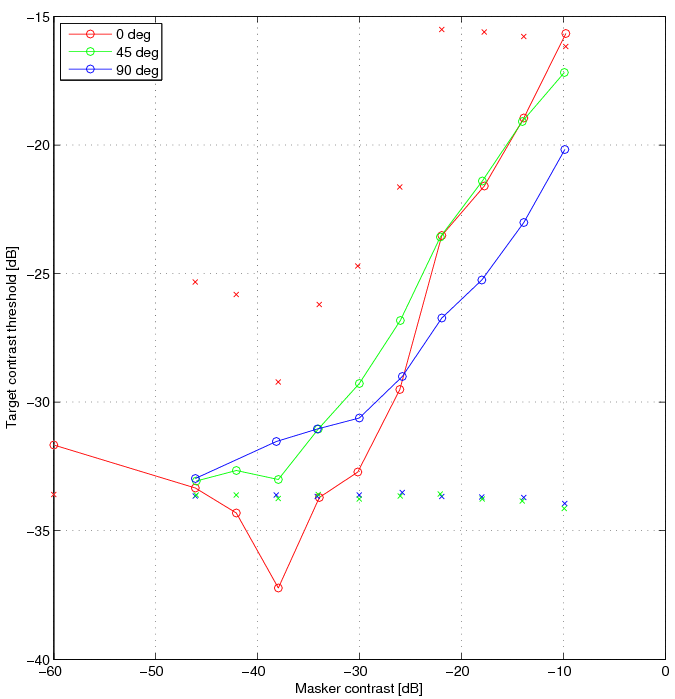
The data set recreates the stimuli used for the contrast masking measurements described in: John M. Foley, "Human luminance pattern-vision mechanisms: masking experiments require a new model," J. Opt. Soc. Am. A 11, 1710-1719 (1994). link. The detection thresholds were read from Figure 3b, data for KMF. Stimuli dimensions have been changed so that all images are square and cyclic.
The stimuli contain the detection thresholds for a Gabor patch in the presence of a masking signal. The masking signal has the same frequency as the Gabor patch. The orientation of the masking signals is 0 deg (the same orientations as the Gabor), 45 deg or 90 deg.
This is the original Visual Difference Predictor based on corresponence with the author and the book chaper: Daly, S. "The Visible Differences Predictor: An Algorithm for the Assessment of Image Fidelity." In Digital Images and Human Vision, edited by Andrew B. Watson, 179-206. MIT Press, 1993.
The metric uses the default parameters from the paper except the masking slope, set to 0.9 for all bands, which was found from fitting the metric to the masking data sets. One optional component in the VDP is computing contrast in the cortex filtered images, which could be either global or local. This version uses global contrast.
The metric also includes an improved variation of the phase uncertainty, as described in: Lukin, A. "Improved Visible Differences Predictor Using a Complex Cortex Transform." In International Conference on Computer Graphics and Vision (GraphiCon), 2009. Phase uncertainty is not mentioned in the '93 book chapter, but is described in the patent application. The method proposed by Lukin achieves the same goals as phase uncertainty but is more elegant and efficient than the approach described in the patent.