Metric fitting results
Metric "HDR-VDP-2"Test set "Glare at scotopic lum."
R = 1.1 dB
chi_2_red = 0.011
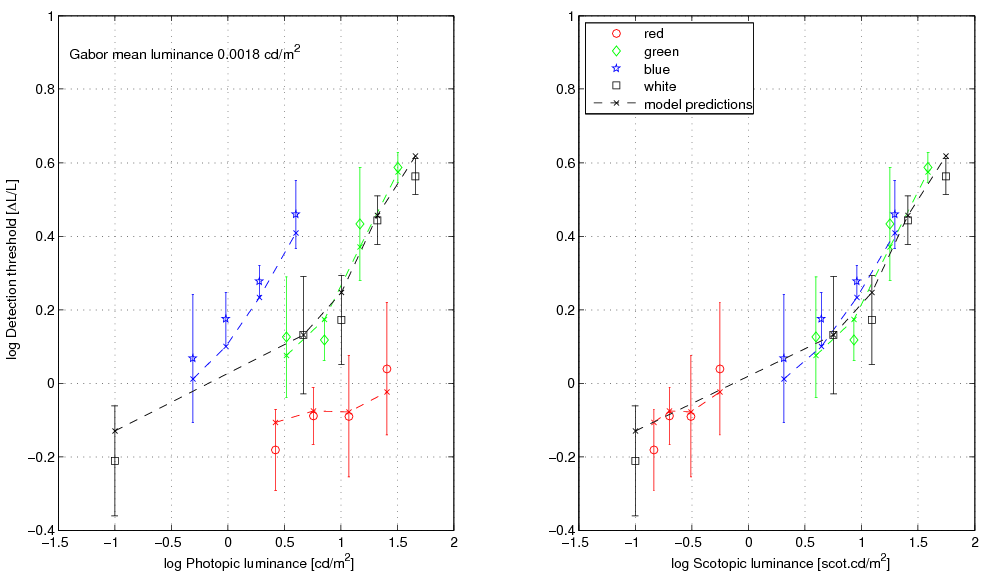
See the gallery of stimuli.
About the data set "Glare at scotopic lum."
Color glare in the scotopic luminance range
This data set shows glare comming from a large color light source
affects detection thresholds at low luminance levels. The original
data from: Mantiuk R, Rempel AG, Heidrich W. Display considerations
for night and low-illumination viewing. In: Proc. of Symposium on
Applied Perception in Graphics and Visualization - APGV
’09. 2009:53-58. link.
The stimuli are 1 cpd dark Gabor patches of background luminance of
0.002 cd/m2 seen in the presence of a strong source of
glare. The prototype display with individually controlled red, green
and blue LED backlight was used to create narrow bandwidth glare
light.
About the metric "HDR-VDP-2"
This is the proposed metric described in
detail in the paper "HDR-VDP-2: A calibrated visual metric for
visibility and quality predictions in all luminance conditions" (doi). It shares
many similarities with VDP'93 and HDR-VDP, as it was inspired by these
metrics, but the functionality is much extended and individual
components are thoroughly revised. The major differences are:
- The metric predicts both visibility (detection/decrimination)
and image quality (mean-opinion-score).
- The metric is based on new CSF measurements, made in the
consistent viewing conditions for a large range of luminance and
frequency.
- The new metric models L-, M-, S- and rod sensitivities and is
sensitive to different spectral characteristic of the incoming
light.
- Photoreceptor light sensitivity is modelled separately for cones
and rods, though L and M cones share the same characteristic.
- The intra-ocular light scatter function (glare) has been fitted
to the experimental data.
- The model used a steerable pyramid rather than cortex transform
to decompose image into spatially- and orientation-selective
bands. Steerable filter introduces less ringing and in general case
is computationally more efficient.
- The new model of contrast masking introduces inter-band masking
and the effect of CSF flattening.
- A simple spatial-integration formula using probability summation
is used to account for the effect of stimuli size.